

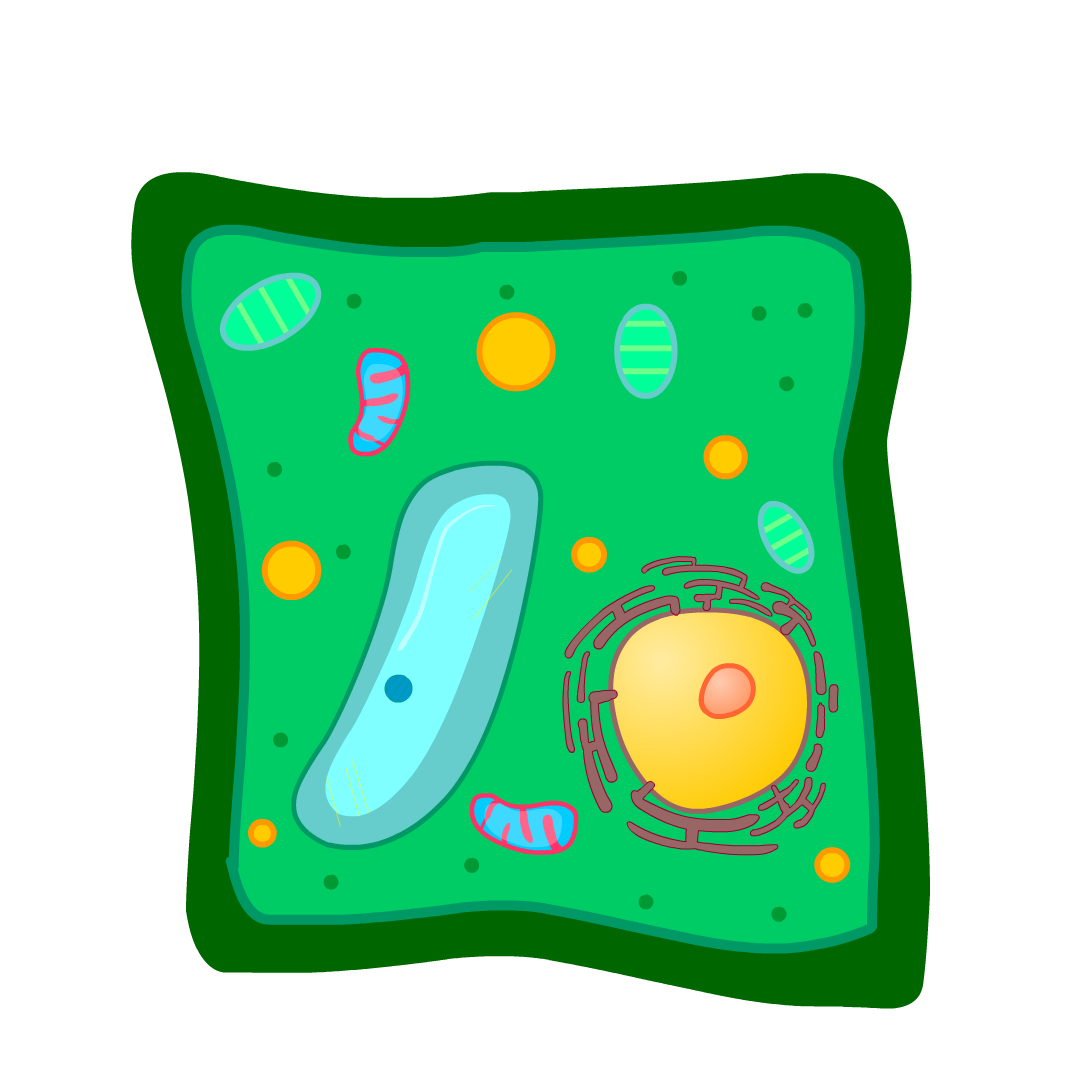

What do we find in a plant cell that we do not find in a human/animal cell?
Cell wall – As you might guess from the name, this is an outer structure of the cell, providing extra support and protection.
Chloroplasts – These are the food producers of the cell. A chloroplast’s job is to convert light energy from the sun into usable sugar for the cell. This process is called photosynthesis, which we can learn more about later.
Also remember these are eukaryote cells that we are looking at above. Below is an example image of a bacteria, which is a single-celled organism. This is a prokaryote cell, with one of the main differences being you find the DNA loose in the cytoplasm, as opposed to being within the nucleus like we see with the animal and plant cells above.


How nature changes, but doesn’t change.
Interestingly, when we look at different levels of nature in this physical universe, we can see similarities in structure, even if what we are looking at is manifesting in different ways. If you have already studied our section on chemistry or physics, you may have noticed the following comparison.
Let’s look below at a diagram of three things: The Cell, The Atom, and the Solar system.
As we can see they all have a very similar structure. A nucleus or a central body, which is surrounded or orbited by other elements within the composition. One could even compare this design to the planet, with the planets core being in place of the nucleus, or even the human body, containing the solar plexus.
