Please wait while flipbook is loading. For more related info, FAQs and issues please refer to DearFlip WordPress Flipbook Plugin Help documentation.
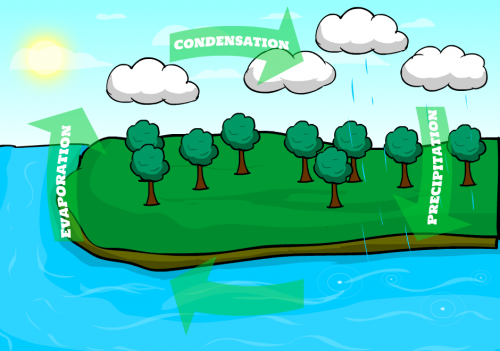
The scientific term for the Water Cycle is Hydrology, which is the branch of study of the nature, transition and spread of water around the planet. The Water Cycle is the continuous cyclical motion of water, in its various forms, in and around the planet Earth. This movement can be split into a sequence of steps as follows: Evaporation (Transpiration, Sublimation), Condensation, Precipitation, Run-off and Infiltration. Not only does the water move around the planet, but also changes it form from one state to another; from ice (solid) to water (liquid) and from water to vapour (gas).
This movement extends high up into the Earth’s atmosphere and deep within the inner rock and caves beneath the surface. At any given time most of the Earth’s surface water exists within the Oceans, which accounts for over 70% of the planets water. The rest of the Earth’s water exists in Glaciers, Rivers, Lakes, beneath the surface within Aquifers and in the air as Water Vapour.
Evaporation is a good starting point in describing the Water Cycle. This is the process where a non-gaseous substance transforms into a gaseous substance as a result of an increase in temperature. In the case of the Water Cycle the ocean water surface is where most of the evaporation takes place. The sun’s energy is transferred as heat to the water molecules, and as a result, receives enough energy to rise into the atmosphere as water vapour. This is an example of a liquid (water) transforming into a gas (water vapour) and dispersing into the atmosphere
Another form of Evaporation is referred to as Transpiration. Transpiration is where water is released into the atmosphere through plant life. The Process of Transpiration as part of the Water Cycle is where plant life absorbs water and nutrients into its roots from the soil. This is carried through the plant as a liquid, and then released through the pores of the leaves into the Atmosphere as water vapour. Water can also be evaporated from the soil and the combination of this with that of transpiration is called Evapotranspiration. The conditions required for these processes to take place are an increase in temperature and humidity and sufficient moisture within the soil.
The final form of Evaporation within the Water Cycle is Sublimation. This differs from normal evaporation because, as a part of this process the solid Ice or Snow, transforms to a gaseous state of water vapour, without having first melted to a liquid state. This normally occurs at high altitude under certain weather conditions, such as snowy mountain tops.
Another good example of Sublimation is in a home freezer where both ice and cold steam are observable to the naked eye.
Condensation is the next step in the sequence of the Water Cycle after Evaporation. Condensation is the process by which Water Vapour (gas) is transformed back into a liquid state. Once Water Vapour is released into the atmosphere, it will rise up to heights of, from approximately, one to seven miles, where clouds are formed. The vast majority of clouds are formed in this layer of the atmosphere called the Troposphere, which extends to about 9 miles above the Earth’s surface.
Precipitation is the next step in the sequence after Condensation. This is where water falls from clouds as snow, hail, sleet or rain, to the various surfaces of the planet, such as the Oceans, Land, Rivers and Lakes. Precipitation is the result of some of the water droplets within the clouds becoming condense and heavy enough such that they will fall to the ground. In other words, the weight of the water droplets has increased so that Gravity will pull them down through the air.
The next stage of the water cycle, after precipitation, is what happens to water, in its various forms, when it reaches the different surfaces of planet.
When water reaches land, it can ‘Run off’ and/or ‘Infiltrate’ into the ground. Run-off is where land surface water flows downhill into streams, rivers and eventually into the Sea and Ocean. This type of Run-off will occur when the land surface is Impermeable, allowing the water to stay above the surface level of the ground. Also a small amount of this surface water can evaporate back into the atmosphere.
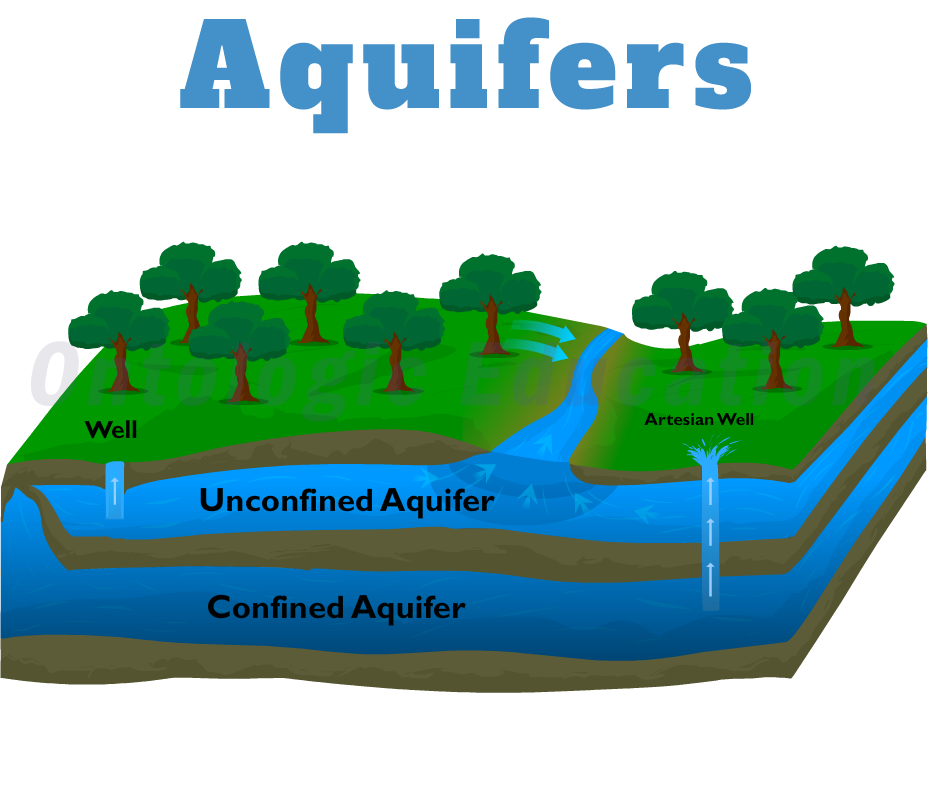
Surface water can also penetrate into the ground. This is called Infiltration. This happens when the ground is Porous, allowing water to seep downwards into underground freshwater storage systems called Aquifers. The Aquifer and its surrounding layers can have a measure of Porosity and Permeability that will filter out any impurities, producing fresh water. The movement of water through aquifers is much slower than that of rivers and will eventually return to the ocean, unless accessed or tapped via Springs or Wells for use for Irrigation and/or drinking water.
Nature Versus Man: Where there is water, there is life and the Water Cycle is nature’s way of preserving life on this planet, by moving water, in its various forms, around the planet and in sufficient quantities for animal and plant life. The following is a list of man-made actions that are having an effect on the Water Cycle.
Deforestation is the conversion of forest land into land that can be used for other purposes such as agriculture, or the building of towns and cities. This reduces the amount of trees, which, in turn, reduces the amount of water vapour released into the atmosphere, affecting the Water Cycle. The amount of forest land reduction is equivalent to the combined size of 200,000 football pitches every day. The Amazon Rain Forest which is the largest in the world has already been reduced by 20%.
Man-made structures, such as Dams, Dykes and Weirs, on Rivers can also have a negative impact to the natural flow of the Water Cycle. Not only can they stop the water from returning to the Oceans, they can also destroy animal habitats, blocking the natural flow of water.
Some of the other areas where the water cycle is being affected are: Over Pumping for Irrigation for water hungry crops, depleted Aquifers and dried out lakes and rivers, Motor Pollution released into the atmosphere, oil spills leading to water pollution and Acid Rain and the Green House Effect, leading to Global Warming, not to mention the disposal of nuclear waste both underground and in the rivers and oceans.
Maybe a strong point can be made by way of the following statement:-
“Just because we can do something doesn’t always mean we should”
Related Articles