
In years of science there have been various theories presented in exactly how and why we age?
Is it the food we eat? Is it the stress we are under? Is it that we have simply been programmed at our very conception and our DNA is moving exactly how it should regardless of outside factors? Most conclude that it is a combination of these factors. But what we’ll look at in this article, is the role that the telomere plays in the aging process. And it may just provide another answer to a question that many have been asking: Why do women live longer than men?
What is a telomere?
Telomeres are essentially caps on the end of our chromosomes, which serve as a protection for the DNA within our cells. Chromosomes need protection from deterioration or fusion with other chromosomes and Telomeres are what provide this. They are often compared to the tips the end of our shoe laces. Without these plastic tips coating the shoelace, the shoelace would become frayed and damage until eventually they could no longer perform their job effectively. This is the same with the Telomeres in relation to our DNA. Without the protection the chromosomes and hence the cells would become damaged and be unable to perform their roles.
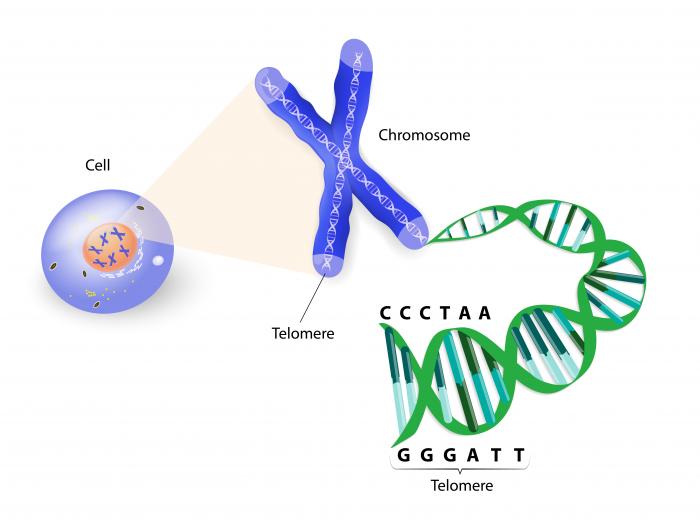
So Telomeres are clearly vital to our health. And another important factor becomes clearer when we understand how exactly our cells replenish themselves. Essentially, in order to replenish and keep our bodies running, our cells copy themselves. This is done through a process known as cell division, which you can read more about here. Without going into the full detail, in order for the cell to copy itself, the DNA within the cell must first replicate. DNA replication is the process by which a DNA molecule is copied to produce two identical DNA molecules. During this replication, the enzymes that replicate DNA cannot continue this duplication all the way to the end of the chromosome, so essentially, during each duplication the end of the chromosome is shortened. The telomeres sit on the end of the chromosome as explained, and act as a protection for the important genes with in the chromosome during this process. It is the telomeres that are shortened during every duplication, rather than important genes being disposed of.
Eventually the telomeres get too short to continue their job, and this is when our cells begin to age and lose function. Telomeres are therefore, acting as the aging clock within every cell.
So in understanding the role of telomeres, we can see that they surely play a crucial role in just how we age. Since the length of your telomeres is different in every human, some might say, that you are programmed to die at a certain point in your life. How your environment and life choices affect this though, is another debate. One thing we can be sure of, is that on average, almost everywhere you go on the planet, women live longer than men. Let’s examine the role of our chromosomes in this fact.

As we say in the picture, females have two X chromosomes, whereas a male has one X and one Y chromosome. This in affect means he has one less tip of you like. With the crucial role that the telomeres play in how slow or fast we age, we can see that just by the very fact of having more telomeres, females may well be designed to live longer. Certainly it is a factor that cannot be ignored.
