Short Paper Study Series
A Water Wheel is a mechanical device that converts the energy, from the motion of water, into a rotating mechanical force. This water motion can be derived from the flowing movement of Streams, Lakes, Rivers and Oceans or from the Gravitational falling motion such as that from Water Falls.
In simple terms, its converts Water Kinetic Energy into rotating kinetic energy, where the force that causes a wheel to spin about its axis is known as Torque
The Water Wheel consists of a wheel, where its circumference is a layer composed of a number of angled paddles (or buckets), which when hit by the force of flowing water, will cause the wheel to spin. Connected to the center of the wheel is a cylindrical shaped bar, referred to as a rod, spindle, or axle, which extends outwards to turn another device or machine such as Mill (Watermills) for grinding grain into flour, crushing fibre for clothing, pounding wood into pulp for paper making, forging iron and even for turning a Generator in order to produce Electricity.
Water Wheel designs can be either Horizontal or Vertical. The horizontal Water Wheel is mostly used where there is a less water, but moving at high speed, such as steep hills where springs exist. The Vertical Water Wheel is more efficient, meaning less energy is wasted in the process, and is the most common.
The various types of Vertical Water Wheels can be categorised into three main types:- Undershot, Overshot and Breastshot.
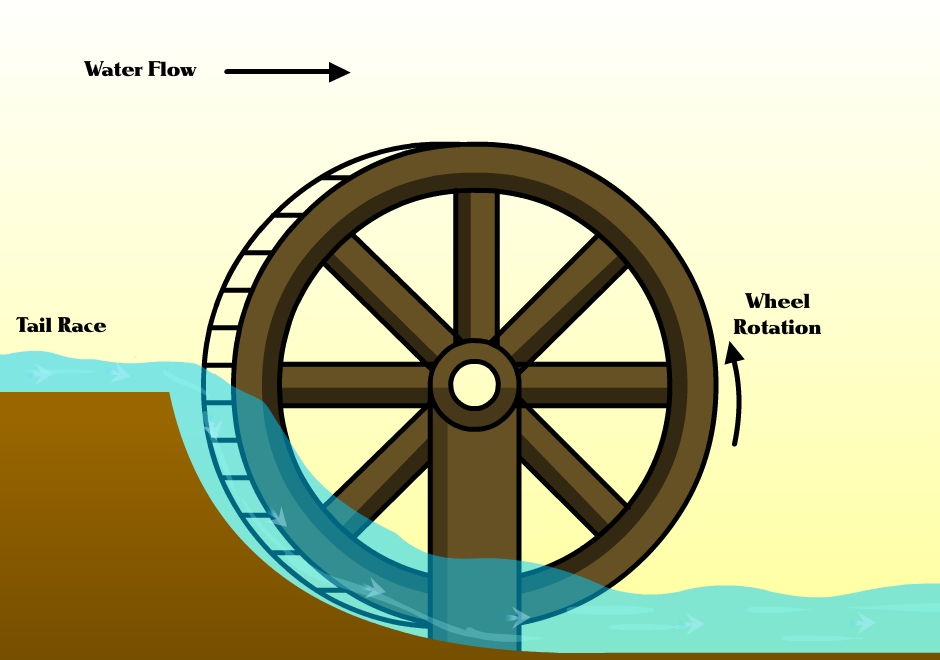
The Undershot Water Wheel is where the lower part of the wheel is submerged in the water source, enough for the impact of the water flow to cause the required rotation. The water source can be a high velocity, not so steep, stream or river, where the rate of flow is the force that causes the wheel to turn. With the Undershot Water Wheel the wheel will turn in the opposite direction to which the water is flowing.

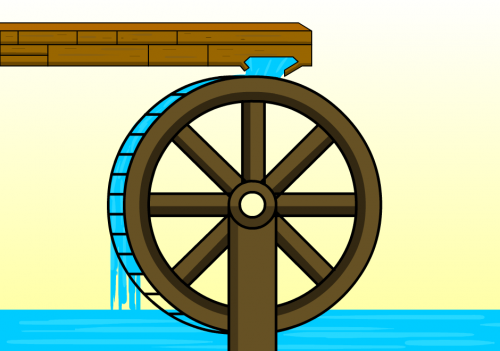
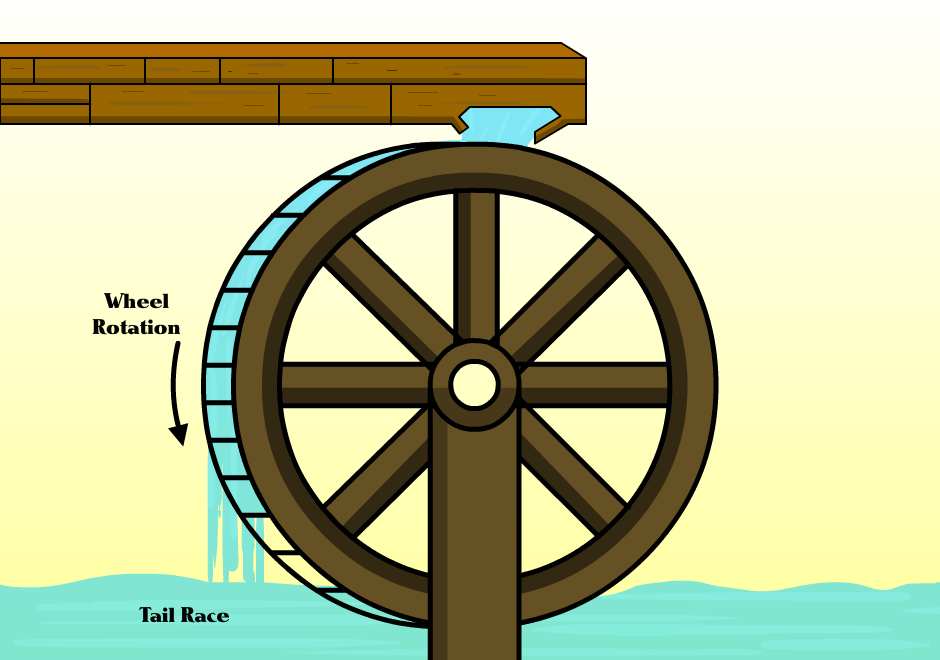
The Overshot Water wheel is considered more Efficient than the undershot because its design incorporates the use of Gravity as a force, combined with the rate of water flow. With the Overshot Water Wheel the Water arrives from above and falls, from a height, onto specially design blades or buckets that can capture and hold the water, causing the wheel to rotate in the same direction as the water flow. When a bucket arrives towards the bottom of the wheel the water empties onto the surface below.
The Breastshot Water Wheel combines both of the design criteria of the Undershot and Overshot, in order to improve the overall efficiency. In this design, the water drops at half the wheel height, filling the bucket and causing the required rotation. The lower portion of the wheel is also submerged in a stream where the impact force of the water flow will provide an additional push. In this design the wheel will rotate in the opposite direction of the water flow.
A Mill is a mechanical crushing devices that breaks various substances into smaller pieces. A Watermill is a combination of a Mill powered by a Water Wheel. For example, a Stonemill, used to grind corn into flour, can be constructed using two concrete rocks, placed together, one stationary and the other made to rotate slowly, on top, in a horizontal motion. The grain is placed between the two rocks and ground into flour.
Typically, the construction of the Watermill would have the water wheel positioned outside of the a building next to a water source such as a Canal, Stream or River. The Mill and the associated machinery will be inside the building and the rotating shaft will extend out of the middle of the wheel, into the building in order to transfer power.
Water Wheels can also be constructed to rotate Generators in order to produce Electricity. This is known as a Hydro Power System. A generators is a device that takes spinning mechanical energy and transforms it into electrical energy using a combination of Magnets and a Conductor Coils (Armature). Hydro Power Systems can range from a small localised system to power a house, to a Hydro Dam System, capable of supplying power to large cities. A good example of a Hydro Dam system would be the Merowe Dam in Sudan, Africa.
Although Hydro Power System can provide Alternative and Renewable Energy, its modern day implementation is a cause for concern. Firstly, most of these systems do not take advantage of the naturally occurring Waterfalls. Instead, really large man-made structures, called Dams and Reservoirs, are built at the expense of destroying large areas of forest land. Less tree to absorb carbon dioxide can contribute to the Greenhouse Effect and Global Warming.
Also, the disturbance to natural rivers can lead to any number of problems; affecting animal Habitats, Fresh Drinking Water and the Indigenous people of the land.